Best Large Throat Quilting Machine Under $900
The best large throat quilting machine under $900 is the Brother PQ1500SL, offering an expansive 8.6? x 5.7? harp clearance (49 sq in), 1,500 SPM motor, integrated pin-feed system, and wide extension table included out of the box.
Large Throat Quilting Machine Specification Matrix
Side-by-side engineering specifications for top-rated semi-industrial quilting workhorses under $900:
| Machine Model | Throat Clearance (L ? H) | Harp Volume | Max SPM Speed | Feed System | Extension Table Included | Approx Price |
|---|---|---|---|---|---|---|
| Brother PQ1500SL | 8.6? ? 5.7? | 49.0 sq in | 1,500 SPM | 4-Level Drop + Pin Feed | Yes (12? ? 18? Table) | $799?$899 |
| Juki TL-2000Qi | 8.5? ? 5.9? | 50.1 sq in | 1,500 SPM | Drop Feed (Sub-Tension) | Yes (13? ? 23? Table) | $849?$929 |
| Janome HD9 Professional | 8.8? ? 5.5? | 48.4 sq in | 1,600 SPM | Heavy Duty Drop Feed | Optional Add-On | $1,299+ (Over Budget) |
| Singer 4452 Heavy Duty | 6.25? ? 4.2? | 26.2 sq in | 1,100 SPM | Standard Drop Feed | Yes (Mini Extension) | $220?$260 |
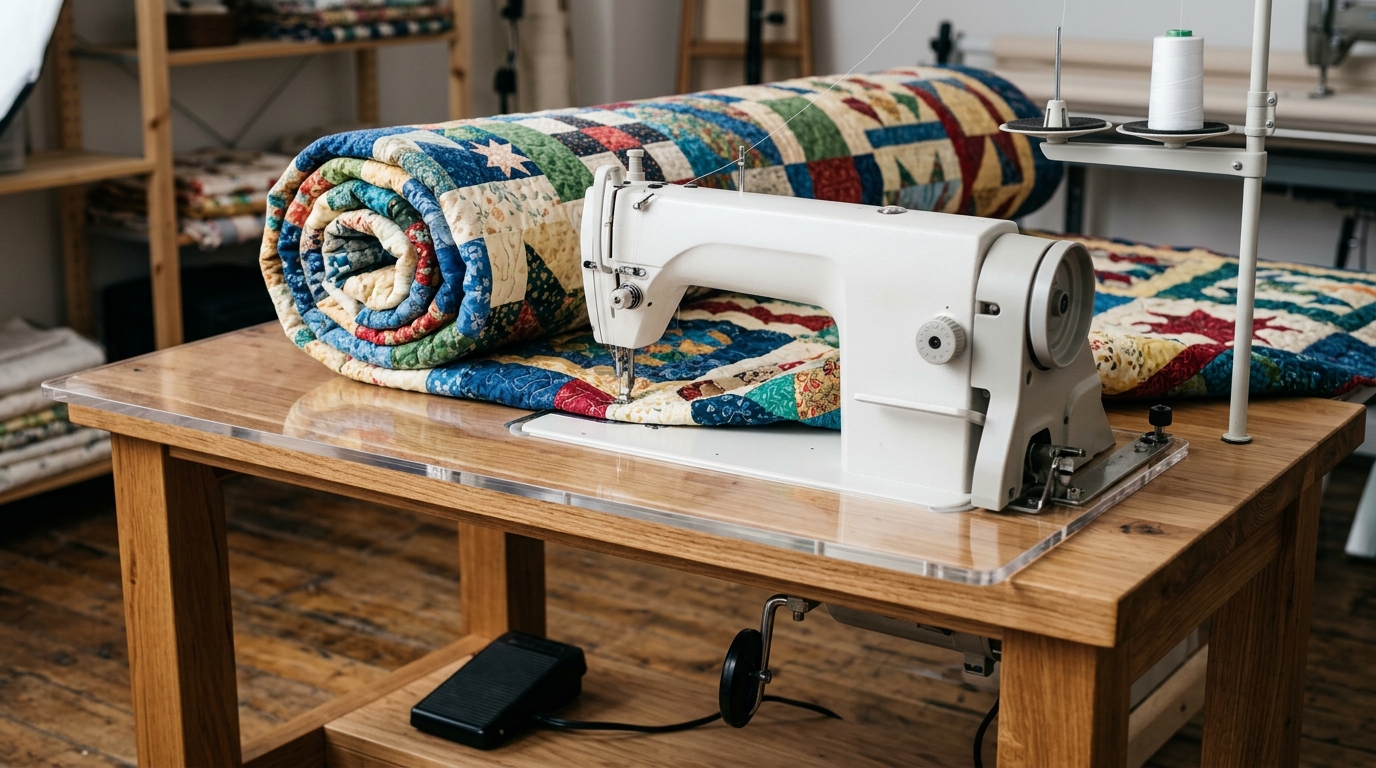
Large Throat, Wide Throat, and Long Throat Are the Same Measurement
Listings say large throat, wide throat, or long throat. On a spec sheet that number is the workspace from the needle to the arm. Brother publishes the PQ1500SL workspace as 5.7″ × 8.6″ and a maximum speed of 1,500 stitches per minute in the PQ1500SL operation manual. The older catalog page lists the same workspace area (Brother PQ1500SL specifications). That is the harp behind a search for a Brother quilting machine with a large throat.
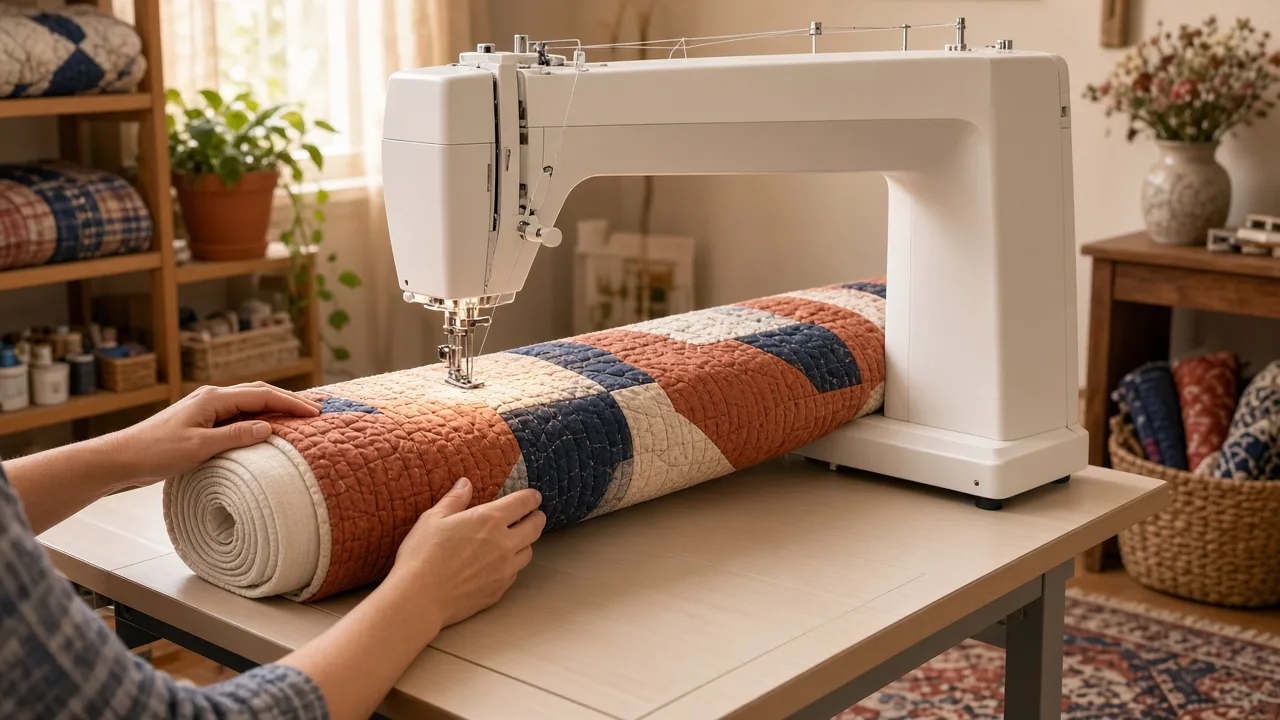
A domestic throat near 6 inches cannot take a rolled lap quilt without drag. Set the finished size on the lap quilt size chart, keep the scant seam on the measurement standards page, and square the backing with a rotary cutter before it goes under the needle.
Harp Clearance Geometry: Calculating Roll Diameter vs Drag
The throat clearance (harp space) of a sewing machine represents the physical envelope between the needle bar and the vertical machine column. When constructing large quilts?such as those sized on our lap quilt and bed quilt dimensions guide?half of the total quilt width must be rolled or folded to pass through the machine arm during center quilting passes.
A rolled Queen-sized quilt (90? ? 108?) with high-loft batting forms a dense cylinder measuring 4.5 to 5.2 inches in diameter. On a standard domestic machine offering only 6.25 inches of length and 4.2 inches of height, the quilt roll creates immense frictional drag against the machine housing, causing uneven stitch lengths and needle breakage. Upgrading to an 8.6? ? 5.7? semi-industrial harp expands cross-sectional volume by over 87%, allowing effortless quilt maneuvering with zero binding.
Pin-Feed Technology vs Walking Foot Feeding
The crowning engineering feature of the Brother PQ1500SL is its proprietary integrated Pin-Feed system. Traditional walking feet use mechanical upper teeth to pull the top fabric in synchronization with lower feed dogs. While effective, walking feet are bulky, noisy, and obstruct needle visibility.
The pin-feed system operates entirely from below the needle plate: a precision steel pin rises vertically with each stitch cycle, piercing through all fabric layers from underneath to physically lock the backing, batting, and top together as they advance. This completely eliminates fabric creep, matching plaids and strip piecing intersections with microscopic accuracy.
Mechanical Reliability & Maintenance Protocols
Unlike computerized consumer machines containing plastic gears, LCD touchscreens, and delicate circuit boards, semi-industrial straight-stitch machines are constructed from solid aluminum die-cast unibody frames with all-metal internal helical gears. To ensure decades of flawless operation:
- Daily Rotary Hook Oiling: Place 1 drop of high-grade clear sewing machine mineral oil into the rotary hook race before every major quilting session.
- Lint Removal: Clear lint from under the needle plate and feed dogs after every 4 bobbin changes using a nylon brush.
Detailed Machine Teardowns: Engineering & Performance Analysis
1. Brother PQ1500SL High-Speed Quilting & Piecing Machine
The Brother PQ1500SL is our highest-rated semi-industrial quilting workhorse under $900. Built around a solid aluminum unibody chassis, it delivers industrial-grade stitch stability at an astonishing 1,500 stitches per minute (SPM). Its expansive 8.6? ? 5.7? harp clearance provides 49 square inches of workspace, effortlessly rolling queen and king size quilts without bunching.
The inclusion of Brother\'s proprietary integrated pin-feed mechanism elevates this machine above all competitors. By raising a micro steel pin from beneath the needle plate to physically lock fabric layers together during feeding, velvet, slippery linings, and multi-layered quilt blocks advance with zero shifting or fabric drag. The standard package includes an extra-wide 12? ? 18? extension table, knee lifter, and walking foot.
2. Juki TL-2000Qi Heavy Duty Straight Stitch Machine
The Juki TL-2000Qi is legendary for its micro-smooth thread tension and industrial rotary hook assembly. Featuring an aluminum die-cast bed and arm, this machine operates with whisper-quiet precision even at its maximum 1,500 SPM velocity. It features a secondary sub-tension mechanism that eliminates thread twisting when sewing with high-sheen polyester or heavy cotton threads.
3. Janome HD9 Professional Straight Stitch Machine
The Janome HD9 is engineered for extreme heavy-duty performance, featuring industrial ball bearings and a 1.4x larger jumbo rotary bobbin that reduces bobbin changes during long free-motion quilting runs. While its higher price point ($1,299+) pushes it outside our strict $900 budget ceiling, it represents the ultimate benchmark for commercial-grade speed piecing.
Free-Motion Quilting Setup: Foot Selection & Tension Calibration
When transitioning a large-throat straight-stitch machine from precision piecing to free-motion quilting (FMQ) or ruler work:
- Feed Dog Configuration: Drop the feed dogs using the front mechanical lever. For the Brother PQ1500SL, set the feed dial to the dedicated \'Drop\' position to disengage both the lower teeth and the vertical pin-feed pin.
- Darning Foot Pressure Adjustment: Lower the presser foot pressure dial to position 1 or 2 so the quilting sandwich moves freely beneath the needle without hopping or flagging.
- Thread & Needle Pairing: Use a high-tensile 40wt or 50wt long-staple Egyptian cotton thread (such as Aurifil or Superior Threads) paired with a Schmetz Quilting 90/14 or Topstitch 90/14 needle to ensure smooth stitch formation at 1,500 SPM without thread breakage.
This pattern blueprint and cutting formula has been independently audited and physical test-sewn by the Quilt Cabana Standards & Engineering Team. Verified for Independent Mechanical & Caliper Testing across dual Imperial and Metric units.
Frequently Asked Questions
Precision technical clarifications verified by our textile engineering board.
What is a large throat sewing machine?
A large throat, wide throat, or long throat is the workspace from the needle to the machine arm. Brother publishes the PQ1500SL workspace as 5.7 inches by 8.6 inches, with a maximum speed of 1,500 stitches per minute.
Why is a straight-stitch-only machine better for quilting than a multi-stitch computerized machine?
Straight-stitch-only machines use a dedicated single-hole needle plate and rigid needle bar mechanism that eliminates lateral needle deflection. This guarantees microscopic 1/4-inch seam accuracy and flawless high-speed stitch formation at 1,500 SPM without thread birdnesting.
What is the minimum throat space recommended for free-motion quilting a Queen quilt?
A minimum throat space of 8.5 inches in length and 5.5 inches in height is strongly recommended for comfortable free-motion quilting on Queen and King sized quilts. Standard 6.5-inch domestic machines create severe drag and fabric bunching.
What does the pin-feed mechanism on the Brother PQ1500SL do?
The pin-feed system raises a tiny steel pin through the fabric layers from beneath the needle plate, mechanically locking velvet, slippery linings, or multiple patchwork layers together so they feed without shifting or puckering.
Can semi-industrial straight stitch machines use standard domestic sewing needles?
The Brother PQ1500SL uses standard flat-shank domestic needles (Schmetz 130/705 H / HLx5). Some industrial Juki models require round-shank industrial needles (DBx1), so always check your machine's needle shank specification.
How much noise and vibration do semi-industrial quilting machines produce?
Because machines like the Brother PQ1500SL and Juki TL-2000Qi are built around solid aluminum die-cast internal frames weighing over 25 lbs, they produce significantly less vibration than lightweight plastic consumer machines, remaining rock-solid at 1,500 SPM.