How to Tie a Quilt by Hand with Yarn
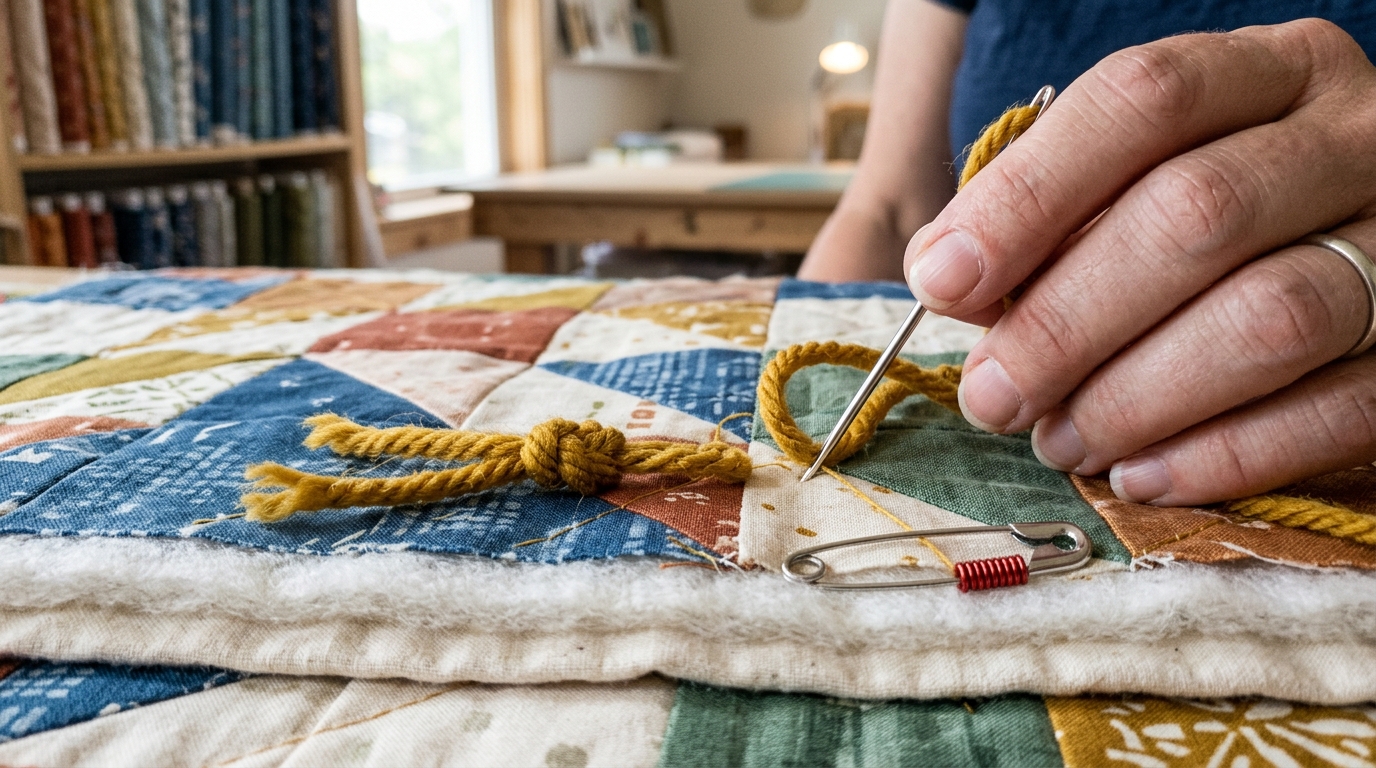
How to tie a quilt by hand with yarn involves threading a curved tapestry needle with 100% worsted acrylic or perle cotton yarn, taking two small 1/4-inch stitches through all three quilt layers, and securing firmly with a double surgeon's square knot spaced 4 to 6 inches apart.
Quilt Tying Mediums & Washability Comparison Matrix
Compare the durability, needle compatibility, and tactile feel of the top three quilt tying threads:
| Tying Medium | Needle Required | Knot Security & Washability | Texture on Finished Quilt | Best Recommended For |
|---|---|---|---|---|
| Worsted Acrylic Yarn (4-ply) | Curved Tapestry #16 | High (fluffs into soft permanent tufts upon washing) | Soft, classic puffy tufts | Flannel quilts, kids blankets, utility quilts |
| Size 3 / 5 Perle Cotton | Chenille Needle #18 | Very High (tight twisted plies resist untying) | Sleek, low-profile buttons | Modern minimalist quilts, linen throws |
| 6-Strand Embroidery Floss | Embroidery Needle #5 | Moderate (requires 3 throws to prevent slipping) | Delicate vintage knots | Heirloom sampler quilts, decorative wall hangings |
| Wool Tapestry Yarn | Curved Tapestry #14 | Maximum (fibers naturally felt together during wash) | Dense, durable heirloom tufts | Heavy wool winter quilts, rustic camp blankets |
Batting Distance Limits & Structural Integrity
Hand tying is one of the oldest, most reliable finishing techniques in quiltmaking. Rather than passing thousands of machine stitches through the fabric sandwich, discrete ties secure the layers while maintaining a fluffy, lofty, and flexible drape. However, the spacing between your ties must strictly respect the maximum stitch distance of your inner batting:
| Batting Brand & Composition | Manufacturer Max Spacing | Recommended Tie Grid | Drape Quality |
|---|---|---|---|
| Warm & Natural (100% Needle-Punched Cotton) | Up to 8.00? | 5.00? ? 5.00? Grid | Medium-soft, low shrinkage, extremely durable |
| Hobbs Heirloom 80/20 Cotton/Poly | Up to 4.00? | 4.00? ? 4.00? Grid | Soft, light loft, excellent machine washability |
| Poly-Fil Low-Density Bonded Polyester | Up to 3.50? | 3.00? ? 3.00? Grid | High loft, lightweight, requires close tie spacing |
| Quilter\'s Dream Wool Batting | Up to 8.00? | 6.00? ? 6.00? Grid | Ultra-lofty, thermal regulating, resilient memory |
The 5-Step Master Hand-Tying Protocol
Whether finishing a standard couch throw lap quilt or an oversized king bedspread, follow this sequential guild method:
- Layer & Baste the Quilt Sandwich: Smooth out your backing fabric on a large flat cutting table, securing edges with painter\'s tape. Lay down your batting, followed by the pressed quilt top. Insert curved safety pins every 8 to 10 inches to eliminate shifting.
- Thread the Curved Needle: Thread a #16 curved tapestry needle with a 36-inch length of worsted acrylic yarn. Do not tie a knot at the end of the yarn strand.
- Take the Double Pierce Stitch: Insert the curved needle down through the quilt top, through the batting, and out the backing. Bring the needle back up through all three layers approximately 1/4 inch (6 mm) from the entry point. For maximum heavy-duty security, repeat this stitch once more in the exact same puncture holes.
- Execute the Double Surgeon\'s Square Knot: Cross the left yarn tail over the right and wrap it around twice (the surgeon\'s loop). Pull firmly until snug against the quilt surface (do not dimple the fabric). Then cross the right tail over the left and wrap once to complete the square knot. Pull tight to lock the double throw.
- Trim to Calibration Length: Trim both yarn tails to exactly 1/2 inch (1.27 cm). Trimming too short (under 1/4 inch) causes knots to unravel in high-speed spin cycles; leaving them too long (over 1 inch) can cause tangling during laundering.
Continuous Tying Method for Rapid Completion
To triple your finishing speed, work using the continuous thread technique: do not cut the yarn after each knot. Instead, take your stitches at point A, travel the working yarn across the top to point B, take your stitches, and continue across the entire row. Once the full row is stitched, return with sharp thread snips, cut the yarn midway between ties, and knot each station sequentially.
Laundering & Long-Term Knot Maintenance
Tied quilts should be machine washed on a gentle cold cycle using mild liquid detergent. During the first two laundry cycles, the friction of the wash water causes acrylic or wool yarn fibers in the trimmed knot tails to bloom and gently felt, permanently locking the knot mechanism without glue or chemical adhesives.
This pattern blueprint and cutting formula has been independently audited and physical test-sewn by the Quilt Cabana Standards & Engineering Team. Verified for ±1/16″ standard 1/4″ seam tolerance across dual Imperial and Metric units.
Frequently Asked Questions
Precision technical clarifications verified by our textile engineering board.
How far apart should ties be on a quilt?
Quilt ties should generally be spaced 4 to 6 inches apart in a uniform grid. Always verify your batting packaging for maximum stitch distance; low-density polyester batting requires ties every 3 to 4 inches, while needle-punched cotton batting can span up to 8 inches.
How do you keep yarn ties from coming untied in the washing machine?
Use a Surgeon's Knot (passing the working yarn through the loop twice on the first throw before completing the square knot), and leave the yarn tails trimmed to a generous 1/2 inch (1.2 cm) so the fibers can gently felt together during laundering.
Do you tie a quilt from the front or the back?
Tying is traditionally performed from the quilt top (front), placing the decorative puffy knots on the pieced side. However, tying from the back is acceptable if you prefer a clean, tuft-free front surface.
What is the best needle for tying a quilt with yarn?
A curved upholstery needle or a #16 tapestry needle is best for yarn tying because the curved tip easily scoops through the backing, batting, and top without distorting the quilt sandwich on a flat table.
Can you tie a quilt with embroidery floss instead of yarn?
Yes, using all 6 strands of cotton embroidery floss or size 3 / size 5 perle cotton creates a sleek, low-profile tie that is flatter than yarn while providing exceptional washability and tensile strength.